
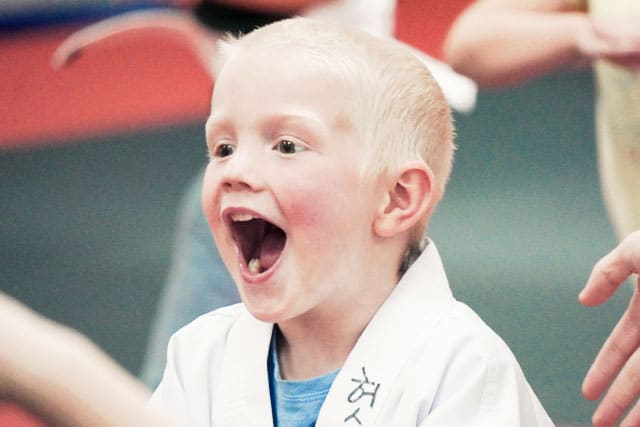
Most parents ask us this question the same way.
Not "are martial arts good for kids." They already believe that part. What they actually want to know is: is my four-year-old going to be the one kid crying in the corner while everyone else kicks?
Fair question. Master Kang was that kid.
He started taekwondo at four years old, in Korea, and he cried through most of his first month. His mother almost pulled him out. He went on to compete internationally. He has now been teaching four-year-olds here in Peachtree City since 2012 — long enough that some of the kids in his first classes are now in college.
So here's the honest version of the answer, with no sales pitch in it. Read all four sections and you'll know whether to sign up this month or wait until spring.
What a 4-year-old actually learns
At four, the skill being taught is not really taekwondo. Taekwondo is the delivery system. Good preschool martial arts is a listening class with kicking in it. The actual curriculum looks like this:
That's it. Six things. If your child leaves our Tiny Warriors program (ages 4–6) able to do those six things, they are ahead of most seven-year-olds who never trained.
What they don't learn (and shouldn't yet)
This is the section most schools skip, so here it is plainly.
3 signs your 4-year-old is ready
Forget age. Look for these three.
If they hit two of three, come try a class. If they hit zero, wait one season. We will tell you that in person too — we'd rather you come back at four and a half and stay for eight years than sign up now and quit in six weeks.
What the first class actually looks like
Practical, minute by minute, so you can picture it:
Before class. Shoes off at the door, socks off on the mat. No uniform needed for a trial — athletic clothes are fine. You check in with Ms. Tasha at the front desk and she'll tell you exactly where to sit.
Minutes 0–5. Kids line up on their own taped spot on the floor. Bow in. Names, one at a time, out loud. This is deliberately the first thing we do.
Minutes 5–12. Movement game disguised as warm-up — animal walks, freeze games, running to color-coded cones. Cardio plus listening, at the same time.
Minutes 12–22. Skill stations. One kicking station with paddles, one balance or agility station. Small group, so your child gets hands-on correction from an instructor, not just crowd instruction.
Minutes 22–28. The word of the day — respect, focus, effort — explained in one sentence, then acted out. They'll be asked what it means at the end. They'll probably tell you in the car.
Minutes 28–30. Bow out. A stripe or a sticker if it was earned. High five at the door.
Where you'll be. On the chair, watching, close enough to see and far enough that your child stops checking. If your child cries, we don't drag them off the mat and we don't hand them straight back to you either — an instructor sits with them at the edge and they rejoin when they're ready. Most kids rejoin in the same class. Some take three classes. That's normal and we've seen it a thousand times.
Where they'll be by week four. Walking in without you. That's the actual milestone.
Come see one class before you decide
Is 4 too young for martial arts? For most kids, no — but the deciding factor is the child standing in front of you, not the number on the calendar. That's not something a website can answer for you.
You do not have to guess. Come watch a Tiny Warriors class, or better, let your child try one.
Master Kang and Master Jeong have been teaching four-year-olds in Peachtree City since 2012. Bring your shy one. We know exactly what to do with them.
And if you're reading this thinking you'd like to train too — the free class applies to every program we run, ages 4 to adult.
Q: Do you teach preschool martial arts in Peachtree City?
Yes. Tiny Warriors is our preschool martial arts program — ages 4–6, 30-minute classes. We've run it here since 2012.
Q: What's the youngest age you accept?
Four. Not "four in a few months" — we've found the difference between 3.5 and 4 is significant at this age.
Q: How long are the classes?
30 minutes for ages 4–6. Long enough to build a habit, short enough that they finish still wanting more.
Q: Do I need to buy a uniform to try?
No. Athletic clothes for the trial class.
Q: My child is extremely shy and won't talk to strangers. Is this a waste of time?
That's the child this program was designed for. Tell us before class so we can pair them with an instructor for the first session.
Q: How often should a 4-year-old train?
Twice a week is the sweet spot. Once a week is slow progress; three or more at this age usually leads to burnout.
