
Will Your Child’s Black Belt Still Count If You Move?
What every Peachtree City parent should know about Kukkiwon certification — before the testing fee, not after.
Peachtree City is a town people move to. It's also a town people move from.
Corporate transfers. Military reassignments. A job in Charlotte, a promotion in Dallas, a grandparent in another state who needs help. Families arrive here for a few good years and then life reroutes them somewhere else.
Which brings up a question almost no parent thinks to ask on the day they enroll their seven-year-old:
If we move, does the belt come with us?
The answer depends entirely on one thing — and it's something you can find out in a single phone call, at any school, including ours.
The Certificate Is the Only Thing That Travels
A belt is fabric. What actually carries value is the certificate behind it, and whether anyone outside the building that issued it has ever heard of it.
There are two kinds of black belt certificates in the world.
The first kind is issued by the school itself. It has the school's logo, the instructor's signature, and a nice border. It is a meaningful memento of your child's effort, and it means exactly nothing to the next school your family walks into. There is no database to check it against. The new school has no way to confirm what your child actually learned, so most will place them where they can see for themselves — often back in the colored belts.
The second kind is registered with the Kukkiwon.
What the Kukkiwon Is
The Kukkiwon (국기원) — World Taekwondo Headquarters — is the official taekwondo institution established by the South Korean government and supervised by Korea's Ministry of Culture, Sports and Tourism. It's been in Seoul since 1972.
It does one thing that matters enormously for a family that might relocate: it keeps a permanent, international, publicly searchable record of every certified black belt holder in the world.
Your child's name. Their date of birth. Their rank. Their certificate number. The date they earned it. Held in Seoul, checkable from anywhere, forever.
That record is why a Kukkiwon-certified black belt earned in Peachtree City is still a black belt in Colorado, in Germany, or in Seoul twenty years from now.
Poom and Dan: What Your Child Actually Earns
This trips up a lot of parents, so it's worth two minutes.
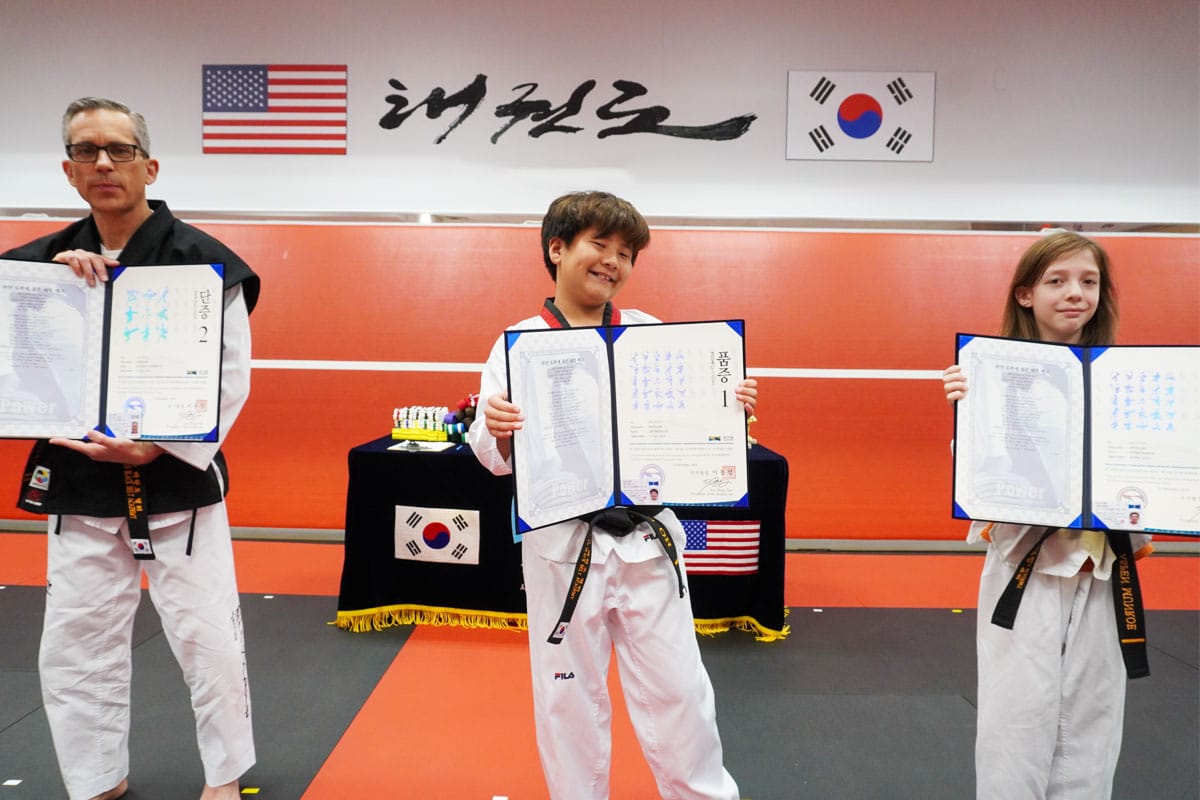
Students under the age of 15 who earn a black belt receive a Poom (품) certificate, not a Dan. A Poom is not a junior belt, a practice belt, or a lesser version. It is the correct certification for a student of that age, issued by the same institution, recorded in the same international database.
When your child reaches the qualifying age, their Poom converts to a Dan (단) — adult certification — without starting over.
So when a school tells you your ten-year-old just earned a black belt, the right follow-up question is:
"Will they receive a Kukkiwon Poom certificate registered in Korea, or a certificate from this school?"
Ask it kindly. Ask it anyway. The answer tells you what the last three years actually bought.
Three Moments When This Suddenly Matters
Parents rarely think about certification at enrollment. They think about it at exactly these three moments — and by then it's retroactive.
Parents rarely think about certification at enrollment. They think about it at exactly these three moments — and by then it's retroactive.
1. The move
New town, new school, first day. The new instructor asks what rank your child holds. With a Kukkiwon certificate, that's a two-minute conversation and your child steps onto the floor at the level they earned. Without one, it's a conversation nobody enjoys having in front of a nervous kid.
2. The competition
Kukkiwon rank is what connects to World Taekwondo — the international federation governing Olympic taekwondo — and to USA Taekwondo, the national governing body recognized by the U.S. Olympic & Paralympic Committee. Sanctioned competition generally requires it. Most kids never go this route. The ones who catch fire at eleven and want to go all in shouldn't discover the door was never open.
3. The return
This is the one that stings most. A teenager quits at fourteen — sports, school, a job. At nineteen they want to come back. With a registered certificate, their rank is still on file and they resume where they left off. Without one, five years of childhood training has no record that it happened.
How to Find Out What Your Child Is Earning
Three questions. Any school. Five minutes.
1. "Is this school Kukkiwon-registered?" A yes is immediate and specific. A pivot to "certificates don't matter, what matters is the training" is itself an answer.
2. "May I see the head instructor's Kukkiwon certificate?" A certified instructor will show you without hesitation. It lists their name, rank, certificate number, and issue date.
3. "When my child tests for black belt, will the certificate be registered with the Kukkiwon?" This is the one that matters. Ask it before you pay a testing fee, not after.
You can also verify an individual's certification yourself: the Kukkiwon maintains a public Poom/Dan lookup at kukkiwon.or.kr, searchable by name — entered in capital letters, with nationality and date of birth — or by certificate number directly.
If Your Child Already Trains Somewhere Else
Some parents read this and get an uneasy feeling about the school their child has attended for two years. So let's be straight about it.
Training is training. The discipline, the fitness, the confidence, the friendships, the habit of showing up on a Tuesday when you don't feel like it — none of that is erased by paperwork. Those years were not wasted.
And not every school outside the Kukkiwon system is a bad school. There are legitimate organizations with other lineages and genuinely skilled instructors teaching under them. The real question isn't which organization — it's whether the credentials can be verified by somebody who didn't take your money.
If the answer turns out to be no, you have options. Most students who transfer into a Kukkiwon school are evaluated and placed at or near their current level, then registered properly from that point forward. Ask about a transfer evaluation. It's a common conversation and nobody starts from zero.
Fourteen Years in Peachtree City
American Black Belt Academy has been teaching on Kelly Drive since 2012. In that time we've watched hundreds of kids come through — and we've watched plenty of them move away.
We are a Kukkiwon-registered school, and our instructors are Kukkiwon-certified.
Every black belt earned in this building is registered with the Kukkiwon in Seoul under your child's own name. Not a certificate we printed. One your child carries for the rest of their life, to whatever town comes next.
Master Ilseob Kang has led this school since it opened. Ask him to show you our certification — he will, and he'll explain exactly what your child will earn and what it's worth outside these walls.
Frequently Asked Questions
Does a black belt transfer between taekwondo schools?
Only if it's registered with a body both schools recognize. A Kukkiwon Poom or Dan certificate transfers internationally because the record lives in a central database, not in one school's filing cabinet. A school-issued certificate generally does not transfer, because there's nothing for the receiving school to verify.
Is a Poom certificate a real black belt?
Yes. Poom is the official Kukkiwon certification for black belt holders under 15, issued by the same institution under the same standards, and it converts to Dan at the qualifying age. It is the correct certificate for a child — not a lesser one.
How long should a child's black belt take?
For a student training consistently two to three times a week, three years and half to five years is realistic and healthy. A guaranteed timeline is a marketing promise, not a training standard.
We might move in two years. Is it still worth starting?
That's exactly when it's most worth starting — as long as the certification is registered. Two years of progress that carries to your next town is two years of progress. Two years that doesn't is a very expensive extracurricular.
Come See a Class
No appointment needed. Watch a full class, ask whatever you want, and ask to see our Kukkiwon certification while you're here.
American Black Belt Academy — Peachtree City
303 Kelly Dr #10, Peachtree City, GA 30269 | (678) 545-1889
The Greatest Power in Life is Discipline.
